Blog ·
WHAT IS SPECTRAL?
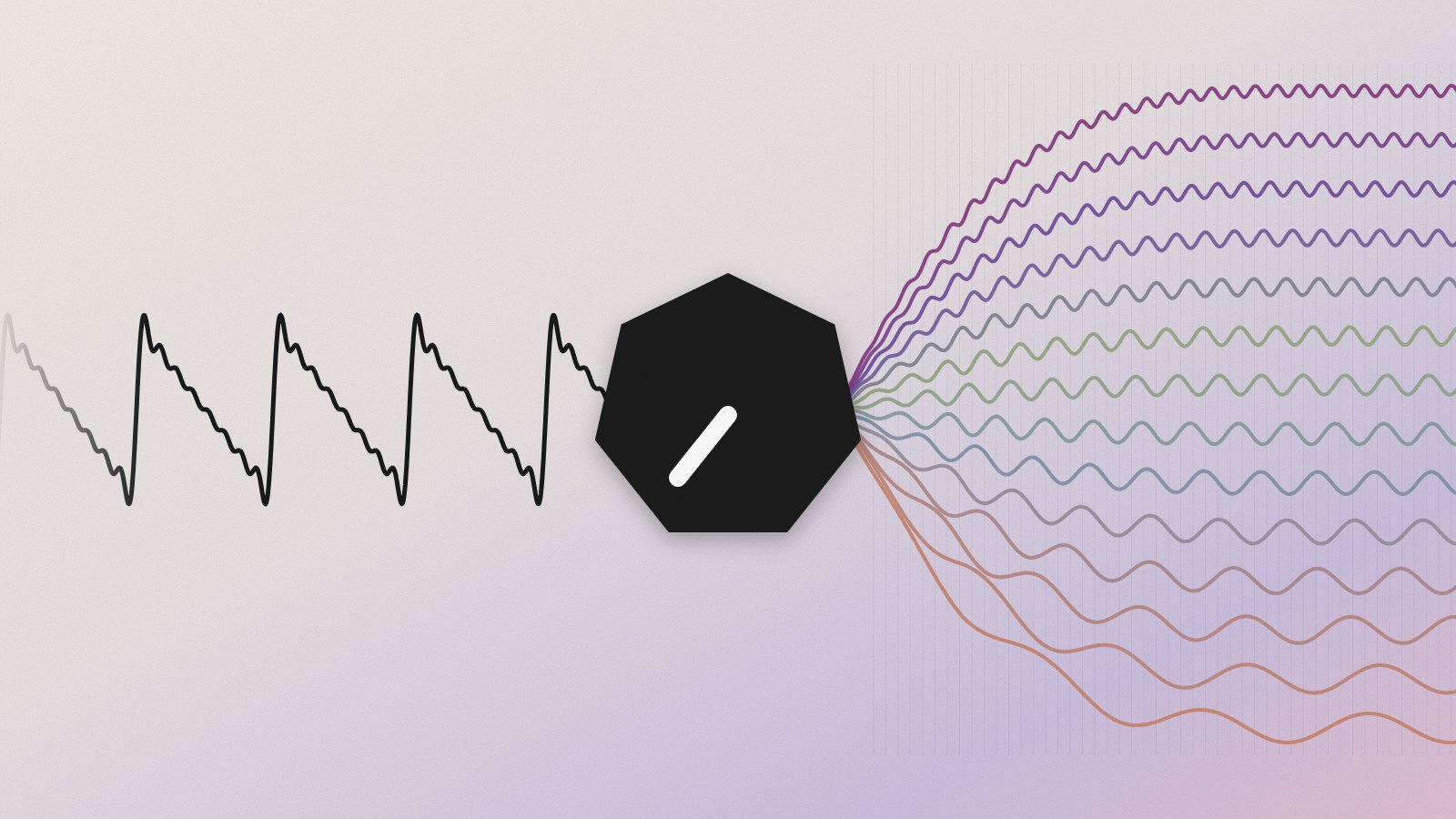
You may have heard the word “spectral” if you spend time around music production, especially in sound-design-heavy genres like dubstep, future bass and color bass. Producers throw it around in plugin names, tutorials and their own descriptions of their sound. But what does spectral actually mean? Why is it presented as such a powerful way to shape your sound? And what’s the math behind it?
Sound is a stack of frequencies
Play a single note on a synth. To your ear it sounds like one thing, but it’s actually many tones stacked on top of each other: a low fundamental, then quieter tones above it at higher frequencies. The mix of those tones is what makes a saw wave sound different from a square wave, or a piano different from a voice playing the same note.
Light works the same way. White light looks like one color, but shine it through a prism and it splits into a rainbow. “Spectral” just means working with that rainbow: the sound split into its individual frequencies.
Normal processing vs. spectral processing
Most effects you use every day work on the sound as a whole. A regular delay repeats everything. A compressor turns everything down when it gets loud. Even an EQ, which does treat frequencies differently, only gives you a handful of bands and applies the same curve the whole time.
A spectral effect first splits the sound into hundreds of thin frequency slices, then lets you treat every slice on its own. Imagine an EQ with a thousand sliders that can each move several times a second, and where each slider can do more than change volume: it can delay that slice, freeze it, move it or smear it.
That’s why spectral effects can do things that are simply impossible otherwise:
- Delay the highs but not the lows, so your hi-hats echo while the bass stays tight.
- Freeze a single moment of a sound and hold it like a pad.
- Smear or scatter frequencies for those glassy, shimmering, “broken” textures.
- Pull noise out of a recording, because the noise lives in different slices than the music.
The math, without the math
All of this rests on one idea from the 1800s by Joseph Fourier: any sound can be described as a sum of simple sine waves at different frequencies. A tool called the FFT (Fast Fourier Transform) is just a very fast way for a computer to answer the question: “How much of each frequency is in this piece of sound right now?”
A spectral plugin does the same few steps over and over:
- Cut the audio into short, overlapping chunks, each about 40 milliseconds long.
- Split each chunk with the FFT into around a thousand frequency slices, each roughly 20 Hz wide.
- Edit the slices: delay some, turn some down, move some around.
- Rebuild each chunk back into normal audio and blend the overlapping chunks together so the joins don’t click.
That’s the whole trick: take it apart, change the pieces, put it back together. The processing happens dozens of times per second, so it feels continuous.
It’s not free
Spectral processing has a few honest trade-offs:
- Time vs. pitch detail: Longer chunks give you finer frequency slices but blurrier timing; shorter chunks keep transients sharp but make the slices wider. You can’t have both at once. This is a real limit of the method, not a bug in any plugin.
- Artifacts: Pushed hard, spectral effects can sound metallic, phasey or “underwater.” Sometimes that’s a problem; in sound design it’s often exactly the character you’re after.
- Latency: The plugin has to collect a full chunk before it can analyze it, so there’s always a small delay. Your DAW compensates for it automatically.
Why it matters
Once you think of a sound as a thousand separate slices instead of one block, a whole new set of moves opens up. That’s what “spectral” really means: not a magic sound, but a different level of control.
That idea is what led me to build Multiway, a spectral delay where every frequency band gets its own delay time and feedback. More on that soon.